
The Perseids are peaking this week, and if you haven’t assembled your dark sky camping gear yet, now is the time to move. This annual meteor shower routinely delivers 50 to 100 shooting stars per hour under ideal conditions — but the difference between a jaw-dropping night and a disappointing one comes down almost entirely to preparation. The right gear keeps you warm, comfortable, and hands-free from dusk until the pre-dawn peak.
I’ve spent the better part of the last several summers chasing dark skies from the Mojave to the Adirondacks, and the setups that work aren’t complicated — they’re just deliberate. Whether you’re rolling up to a designated dark sky park or pushing deeper into the backcountry, this guide covers every category that matters: lighting, seating, warmth, navigation, and astrophotography. If you want to go lighter and farther for your meteor watch, we also put together a deep-dive on 10 essential dark sky backpacking gear picks for overnight meteor watching that complements everything here.
Below you’ll find 12 gear essentials organized into practical categories, with specific product picks at every price point. No filler, no fluff — just what you actually need to be lying on your back watching fireballs at 2 a.m.
Best Dark Sky Camping Gear: Lighting That Protects Your Night Vision
This is the single most important category, and also the most misunderstood. White light destroys your dark-adapted vision in seconds and takes 20 to 30 minutes to fully recover. Every light source in your campsite needs to be red-spectrum only on meteor shower nights. That includes your phone screen — most phones have a red-tint mode buried in accessibility settings, and you should enable it before you arrive.
A dedicated red-light headlamp is non-negotiable. Look for a model that operates exclusively in red mode without accidentally switching to white — this rules out a surprising number of otherwise excellent headlamps. The beam should be just bright enough to navigate camp safely; you don’t need 300 lumens when you’re just walking to the water jug.
1. Black Diamond Spot 400 Headlamp ⭐⭐⭐⭐⭐
The Spot 400 has a dedicated red LED mode with a separate power sequence that won’t accidentally blast you with white light. The dimming control is smooth, battery life is strong at around 200 hours on low, and it’s IPX8 waterproof. This is the headlamp I’ve used on more dark sky nights than any other.
Pros:
- ✅ Dedicated red mode with no accidental white-light activation
- ✅ Excellent battery life and waterproofing
Cons:
- ⚠️ Slightly heavier than ultralight competitors
2. Petzl Tikka Core Headlamp ⭐⭐⭐⭐
The Tikka Core runs on a rechargeable internal battery via USB-C, which simplifies packing — no spare AAs rattling around. Red mode is clean, the interface is intuitive, and it’s compact enough that you’ll forget it’s on your head. Great mid-range pick for car campers and backpackers alike.
Pros:
- ✅ USB-C rechargeable — no disposable batteries
- ✅ Lightweight and packable at 79 grams
Cons:
- ⚠️ Can’t swap batteries in the field if it dies
Reclining Camp Chairs and Comfort Gear for All-Night Watching
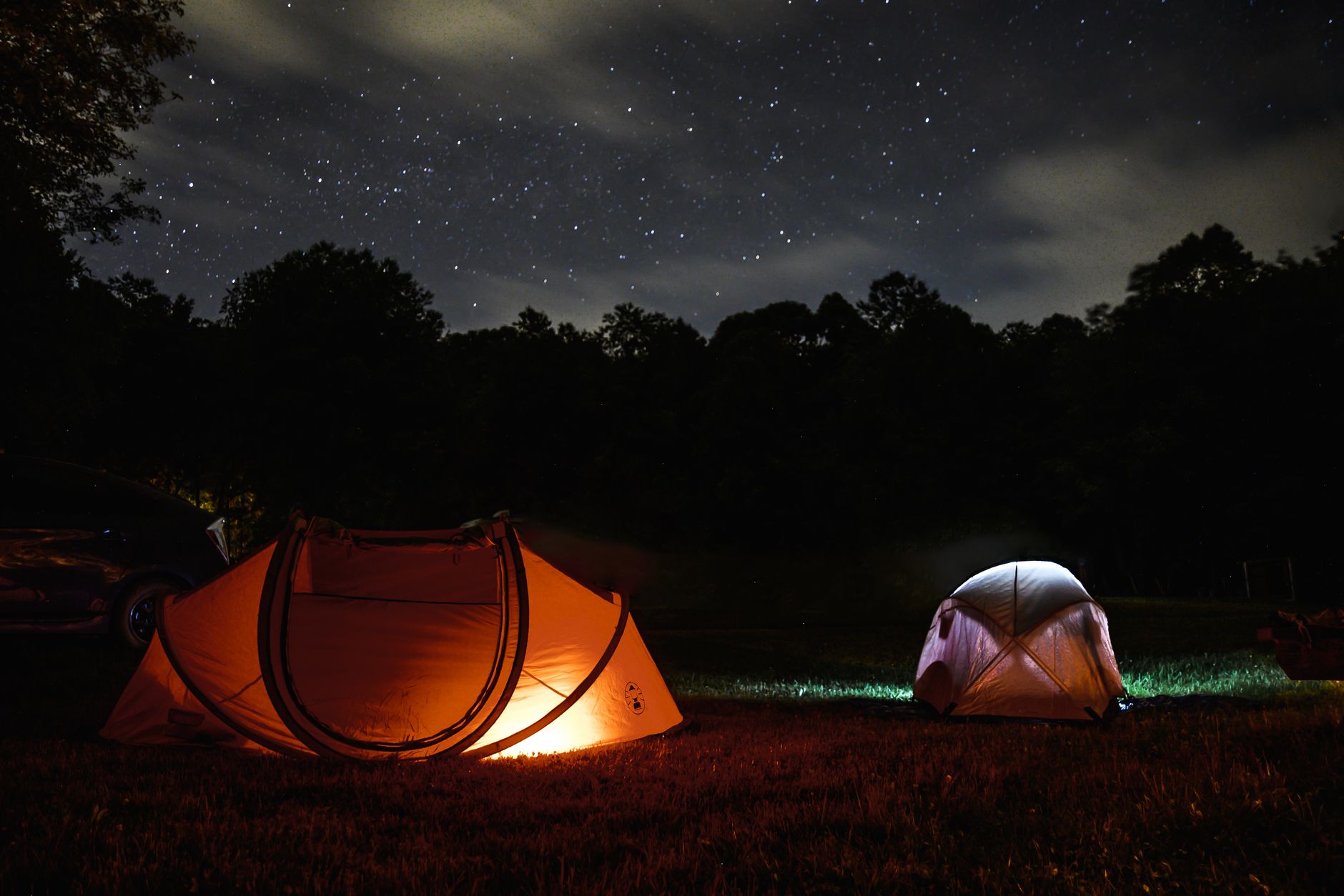
Lying flat on your back for three or four hours watching meteors sounds romantic until your lower back starts screaming at hour one. A proper reclining camp chair changes everything. You want something that reclines to near-horizontal, has a headrest, and won’t tip over when you inevitably shift to track a fireball across the sky. Zero-gravity chairs are the gold standard here — they distribute weight evenly and most can lay nearly flat.
If you’re going ultralight or backpacking to your dark sky spot, a lightweight reclining camp chair paired with a closed-cell foam pad as a footrest is the best compromise. Whatever you choose, set it up on flat ground, point it north or northeast for the Perseids, and have a packable blanket within arm’s reach before darkness falls.
3. Timber Ridge Zero Gravity Reclining Chair ⭐⭐⭐⭐⭐
This is the chair I recommend to every dark sky camper who asks. It reclines fully, supports up to 350 lbs, folds flat for car camping transport, and has a padded headrest and side table. The textilene mesh breathes in warm August nights and the locking mechanism holds your recline angle reliably. It’s a car-camping staple that earns its weight every single time.
Pros:
- ✅ Full recline to near-horizontal — ideal for sky watching
- ✅ Built-in headrest and cup holder
Cons:
- ⚠️ Too bulky for backpacking — car camping only

Packable Blankets and Layering for Cold Desert Nights
August nights at elevation — or in the desert — get cold fast. Even in the American Southwest, temperatures at 6,000 feet can drop into the 40s by 2 a.m. A packable blanket is one of those items that seems optional until the moment you desperately need it. Puffy synthetic blankets compress small, warm fast, and handle the inevitable dew that settles on everything after midnight.
Don’t rely on your sleeping bag alone. A blanket lets you stay in your recliner or on a ground tarp without the confinement of a mummy bag — you want freedom of movement so you can swing your gaze across the whole sky. Layer a puffy blanket over your legs and lower torso, keep a fleece or softshell jacket on top, and you’ll be comfortable through the Perseid peak hours between midnight and 4 a.m.
4. Rumpl Original Puffy Blanket ⭐⭐⭐⭐⭐
The Rumpl is the benchmark for packable outdoor blankets. Made from recycled ripstop nylon with PrimaLoft insulation, it compresses to about the size of a Nalgene, weighs under two pounds, and is treated with a DWR finish that sheds light moisture. The full-size version (50 x 70 inches) is big enough to cover two people in chairs, making it ideal for a Perseid watch with a partner.
Pros:
- ✅ Packs small, weighs little, warms a lot
- ✅ DWR coating handles dew and light rain
Cons:
- ⚠️ Premium price — budget options exist but don’t compress as well

Star-Finding Apps and Camera Tripods for Astrophotography
Two categories that go hand-in-hand: knowing where to look, and capturing what you see. Star-finding apps have matured dramatically — the best ones now show real-time meteor radiant points, satellite tracks, and ISS passes overlaid on live sky maps. Stellarium Mobile Plus and SkySafari 7 are the top picks. Stellarium’s free version covers most use cases; the paid upgrade adds a deeper catalog and offline functionality that matters in dead zones. Set your phone to red-night mode before opening any app.
For astrophotography, a sturdy tripod is the essential foundation. Meteor photography requires long exposures — typically 15 to 25 seconds at f/2.8, ISO 1600 to 3200 — so any vibration ruins the shot. A travel tripod that handles a mirrorless camera or even a modern smartphone rig is sufficient for most dark sky campers. Look for a tripod with a ball head that locks solidly and legs that spread wide for stability on uneven ground.
5. Joby GorillaPod 5K Carbon Tripod ⭐⭐⭐⭐
The GorillaPod is the go-to travel tripod for dark sky campers who want portability without sacrificing stability. The flexible legs wrap around poles, rocks, or fence posts to get creative angles, and the carbon fiber version keeps weight under 1.5 lbs. It handles mirrorless cameras and DSLRs up to 5 kg. Pair it with an intervalometer and you can run a full night of automated exposure sequences without touching the camera.
Pros:
- ✅ Flexible legs work on any terrain
- ✅ Carbon fiber build keeps weight minimal
Cons:
- ⚠️ Not ideal for very wide landscape compositions at maximum height
Top Dark Sky Campgrounds to Hit Before the Perseids Peak
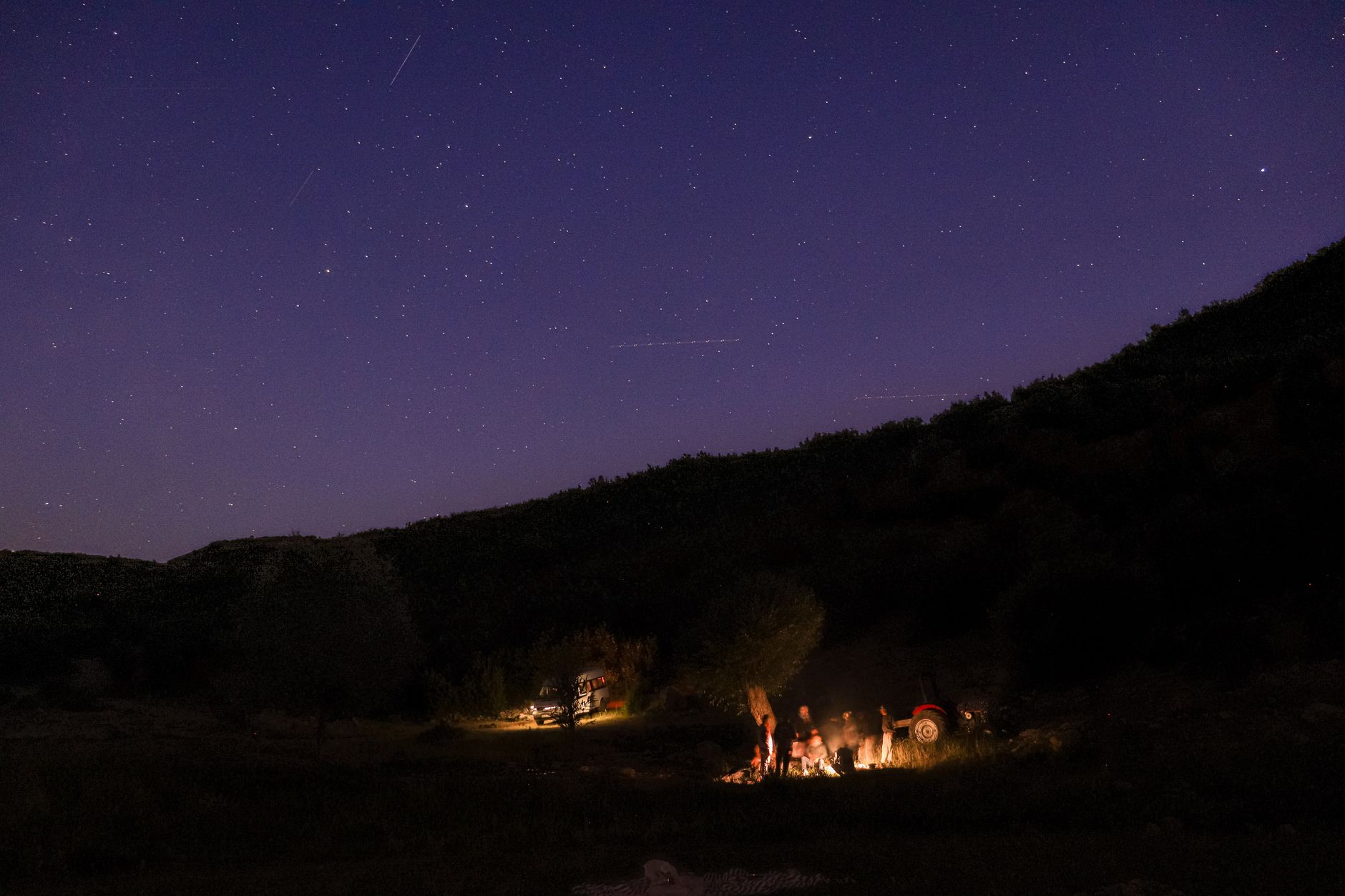
Gear is only half the equation. The campground matters just as much. Bortle Class 1 and 2 skies — the darkest on the scale — are found in a shrinking number of places, and the best ones book up weeks in advance during Perseid season. In the western U.S., Cherry Creek State Park in Colorado, Great Basin National Park in Nevada, and the Cosmic Campground in New Mexico (a designated International Dark Sky Sanctuary) are top choices. In the East, Cherry Springs State Park in Pennsylvania regularly ranks among the darkest sites east of the Mississippi.
When evaluating a campsite for a meteor watch, check the terrain for natural light-blocking features to your north and northeast — tree lines, ridges, or canyon walls that block distant town glow are a major advantage. Arrive before sunset to set up your dark sky camping gear, orient your chair, and let your eyes begin adapting before full darkness. Avoid sites near bathrooms or parking areas where other campers’ car headlights will repeatedly destroy your night vision.
Download your offline maps and star charts before you leave cell coverage — a lesson that applies beyond just stargazing. And bring more warm layers than you think you need. Every time. Without exception.

Conclusion
The Perseid meteor shower doesn’t wait for you to get your kit together. With the peak hitting this week, the window to grab the right dark sky camping gear and find your site is right now. A red-light headlamp, a reclining chair, a packable blanket, a reliable star app, and a solid tripod will cover the core of what you need. Everything else on this list layers on top of that foundation.
Get out there. Go dark. Look up. The sky puts on this show every year, but a fully dark, moonless Perseid peak doesn’t come around every season — and when conditions align, it’s one of the best free experiences in the outdoor world. Don’t miss it because you forgot a blanket.
Shop Backcountry Gear Labs on Etsy
Hoodies, tees, hats, and more for campers and hikers who live for the trail.
Get Weekly Gear Picks
Join the Backcountry Gear Labs newsletter for expert gear picks and backcountry advice, every week.